
Cloud Security Intent Enforcement: Stop Risk Before It Exists
SACR's new CISO's Guide defines Cloud Security Intent Enforcement (CSIE) as its own layer of cloud security. What it means, where it sits next to your CNAPP, and how Aryon maps to it.


Every cloud security team already knows what should be true. No public storage. No wildcard trust policies. Encryption at rest everywhere. Agents can reach these services and not those. The hard part is keeping it true while hundreds of people, pipelines, vendors and agents change the cloud every day.
SACR's The CISO's Guide to Cloud Security Intent Enforcement, published October 28, names that gap and the layer that closes it. This post walks through SACR's definition, the test behind it, the five-stage loop, and how Aryon fits.
Cloud Security Intent Enforcement, as SACR defines it
SACR defines CSIE as the control layer that takes cloud context and security intent, translates the intent into enforceable controls, evaluates the likely impact, applies the control at an enforcement point, and keeps the intended state in place over time. The goal is to stop rediscovering and fixing the same unsafe conditions.
To count as CSIE, a product has to prevent a prohibited state before it becomes active. Discovery, prioritization, recommendations, tickets and generated fixes don't qualify on their own. Neither does finding an unsafe state and auto-remediating it. The control has to reach an authoritative enforcement point.
Plenty of tools call themselves preventive. SACR's test cuts through that: did the unsafe resource ever exist? If yes, even for seconds, it was remediation.
The five-stage loop
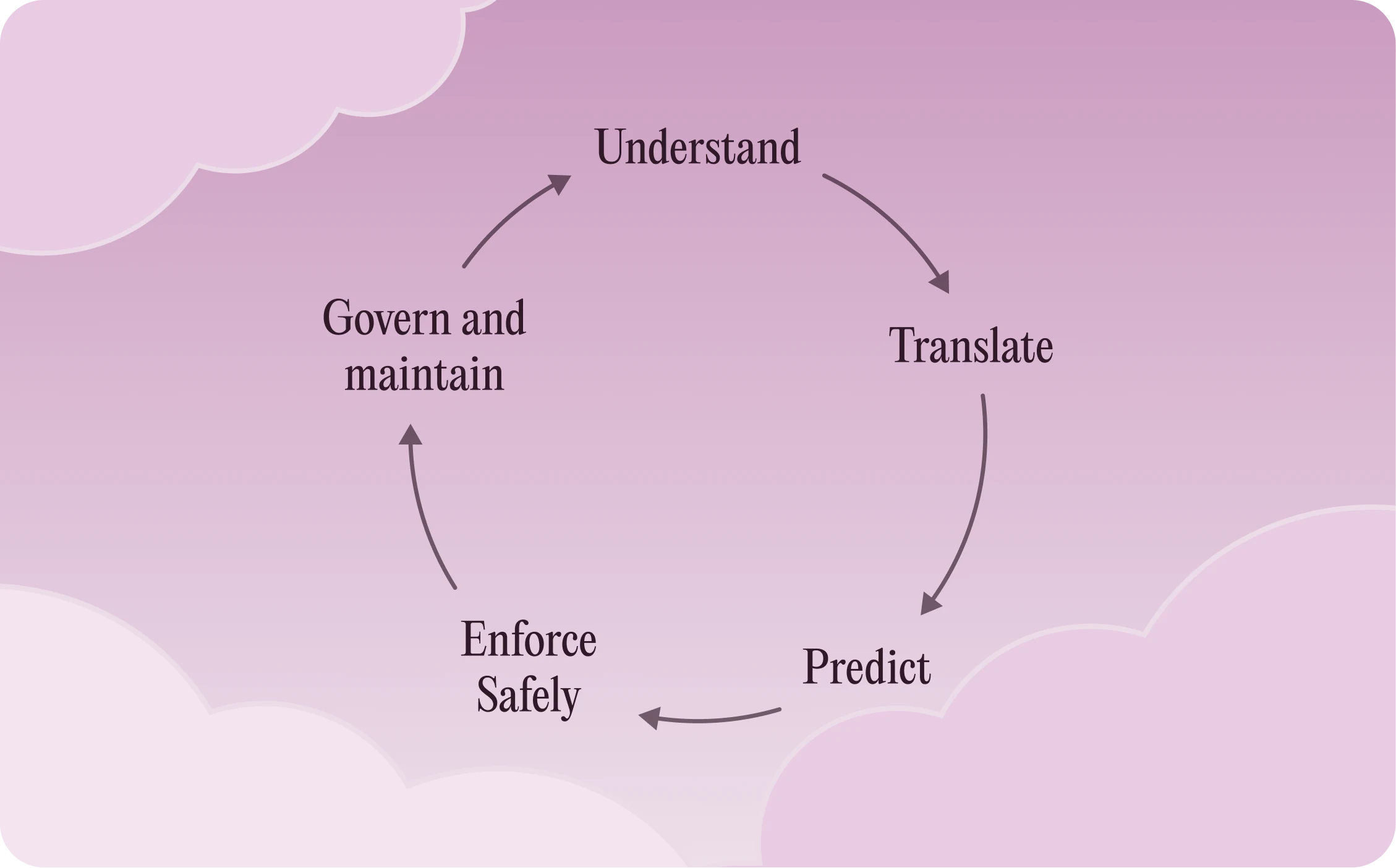
SACR frames CSIE as a loop, because the cloud never stops changing: Understand → Translate → Predict → Enforce safely → Govern and maintain. Here's each stage, and what it looks like in Aryon.
Understand. Build the context that defines intent: identities, applications, agents, data, reachability. For posture intent, a required configuration or benchmark. In Aryon, intent is expressed as policies grouped into initiatives: encryption, identity, a compliance framework's technical safeguards, a known attack pattern. Recommendations come from the real changes in your environment, and a research team writes policies for new failure modes as they appear.
Translate. Turn intent into cloud-specific controls. Aryon manages each cloud's native enforcement service (AWS SCPs and RCPs, Azure Policy, Google Cloud Organization Policy) from one place, with one rollout, approval and exception model. Because the control is the provider's own mechanism, it is authoritative.
Predict. Before broad enforcement, show what risk goes away and which workflows could break. Aryon runs every policy against real activity in your tenant with nothing blocked. You see what prevent mode would have stopped, and which existing resources already violate, before a single block is real. SACR calls credible pre-enforcement impact assessment the thing teams need in order to act. Put more bluntly, it's the difference between a policy program stuck in alert-only and one that enforces.
Enforce safely. Apply the approved control at the authoritative enforcement point, with staged rollout and rollback. Aryon enforces at the cloud control plane, the one layer every change passes through. A non-compliant request is denied before the resource exists. The response carries the policy that fired and the change that would pass. Only new and modified resources are affected; nothing running is touched. Promote a policy one scope at a time, dev before prod or the reverse, and roll it back the same way.
Govern and maintain. Exceptions, approvals, drift and ongoing verification. In Aryon, an exception is requested from the denial itself and approved in the app or in Teams. It's scoped, time-bound and audited. Drift against policy is tracked, and the research team keeps the library current.
Every path in, or it doesn't count
One line in SACR's evaluation criteria deserves its own section. Under "Intent and Prevention," the report says evidence from one change source doesn't prove enforcement across all sources. Then it lists them: console, CLI and PowerShell, APIs, IaC, CI/CD, scripts, third-party systems, and AI and coding agents.
A control that only sees the pipeline has a hole shaped like everything that isn't the pipeline. The console isn't the pipeline. A vendor's script isn't. An agent calling the cloud API directly definitely isn't.
How Aryon helps: Aryon enforces at the cloud control plane, the one place all of those paths converge. Console, CLI, API, IaC, pipeline, script or agent, every change passes the same rule.
AI Agents: enforce the boundary, not the prompt
The guide's section on AI agents is the most useful part for anyone being asked to let agents build infrastructure. Agents inherit human or service identities. They can use overly broad access faster, and at larger scale, than a person would. SACR's answer is to restrict the environment the agent operates in, rather than try to predict every action it might take. One line stands out: instructions inside an agent are not a cloud control. The boundary has to be enforced in the underlying environment.
There's a growing category of tools for what agents say and call. This is about what agents build. Both matter, but only one stops a misconfigured resource from existing.
How Aryon helps: Every agent hits the same control-plane rule. The denial returns the policy and the fix in the API response the agent already parses, so it retries compliant without a ticket or an SDK.
Where this sits next to your CNAPP
SACR is clear that CSIE is not CNAPP 2.0. CNAPP supplies much of the context prevention needs (findings, identities, exposures, attack paths) and keeps doing that. CSIE asks different questions. Which states should be permitted? What control stops the unsafe state from recurring? What legitimate work does it affect, and can it be introduced without disruption?
How Aryon helps: Many Aryon customers already run it this way, alongside a CNAPP. The CNAPP finds and prioritizes; Aryon enforces; the backlog stops growing. SACR's recommendation is the same: an enforcement and governance layer next to CNAPP, not a replacement for it.
Six questions to bring to a demo
SACR closes its evaluation criteria with six questions for any vendor claiming this layer. Can you start from a real architecture and show a policy's expected impact before enforcement? What happens when legitimate activity is blocked? Can the control be staged and rolled back quickly? Does it hold for console, API and IaC changes, not just pipeline changes? Do exceptions expire automatically? If the platform goes down, do existing controls keep working?
Bring those to any demo, ours included. Want to learn more? Schedule a personalized demo with the Aryon team.
The CISO's Guide to Cloud Security Intent Enforcement is available from SACR. Aryon is one of the report's sponsors; the analysis and conclusions are SACR's own.

Continue reading
From the Frontlines: Why SecOps and Incident Response Need Prevention in the Cloud
In the incidents I handled, the adversary rarely needed a zero-day. They only needed one setting to be wrong. In the cloud, that setting can expose an entire data store, sometimes for just a few minutes, and attackers now move faster than detection can: the average breakout takes 29 minutes, the fastest 27 seconds. Here is what I saw from the frontlines, and why SecOps and incident response teams should start with prevention.
The Regulator Did Not Fine Them for the Bug
885 million mortgage documents were open to anyone who could change a digit in a web address, and the company’s own security team had found the flaw five months before a journalist reported it. Yet when New York’s financial regulator brought its first-ever cybersecurity enforcement action, it did not fine First American for the bug. It asked whether the company’s environment was under control. That is the question every Part 500 examination comes back to.

Shipping and Maritime: A Cyber Incident Is Now a Hazardous Condition
As of July 2025, the US Coast Guard treats a cyber incident as a hazardous condition, in the same regime as a fire or a grounding. In shipping, that is not a compliance footnote. It recognizes what an attack actually takes away: not records, but the ability to operate.

Healthcare: The Most Expensive Sector to Get Wrong
Healthcare faces the highest data breach costs of any industry, averaging $6.64 million per incident in 2026. As cloud adoption accelerates, misconfigurations threaten patient data, HIPAA compliance, and critical clinical operations. Discover why detection alone isn't enough and how preventive cloud security stops risky configurations before deployment-without disrupting patient care.
Exploiting Cloud Misconfigurations, Part 2: How Attackers Discover Cloud Resources
The first thing an attacker needs is a target, so an attack naturally begins with resource discovery. During discovery, the attacker builds and expands a database of resource identifiers. These resources are then checked periodically for exploitable conditions. A resource may be discovered long before an opportunity to exploit it arises.

Ten Years Is a Long Time to Be Wrong
For nearly a decade, a cloud misconfiguration at Toyota left sensitive vehicle data belonging to approximately 2.15 million customers accessible from the internet. What began as a single configuration mistake in 2013 went undetected until 2023, exposing a fundamental weakness in traditional cloud security: detecting misconfigurations only works when someone is looking. And when Toyota finally investigated, it uncovered additional exposures. The incident raises a critical question for every organization operating in the cloud: Why wait to discover a security risk when you could prevent it from existing in the first place?